When patients research dental implants, one of the first questions they often ask is:
“Which implant brand is the best?”
The implant system certainly matters. Implant design, surface characteristics, components, clinical evidence and quality control are all important.
But there is another factor that is often even more critical to the final result: where and how the implant is positioned.
A high-quality implant placed in an inappropriate position can create restorative, biological or aesthetic problems. On the other hand, a well-planned implant placed correctly within suitable anatomy can provide an excellent foundation for a long-lasting restoration.
This is particularly important for front teeth, multiple implants and full-mouth implant rehabilitation.
🦷 What Does 'Correct Implant Position' Actually Mean?
Implant positioning isn't simply about placing the implant in the middle of the available bone.
The implant has to be positioned in three dimensions:
- Mesiodistally — the correct position between neighbouring teeth or implants
- Buccolingually — the correct position from cheek/lip side to tongue/palate side
- Vertically — the appropriate depth within the bone
The angulation of the implant is also critical.
Most importantly, the implant position should be planned around the final restoration.
This is called prosthetically driven implant placement.
In simple terms:
Don't place the implant first and then figure out the tooth. Plan the tooth first and position the implant to support it.
🦷 Why Does Implant Position Matter So Much?
An implant becomes the foundation for the future crown, bridge or full-arch prosthesis.
If that foundation is incorrectly positioned, the problems can extend all the way to the final tooth.
1. It Determines How the Final Crown Looks
For a front tooth, even a relatively small positional error can affect:
- Crown emergence
- Tooth proportions
- Gum contour
- Symmetry
- Smile aesthetics
An implant placed too far toward the lip, for example, may result in an unfavourable crown contour or compromise the surrounding tissues.
🦷 2. It Affects the Gums and Bone
Implants interact with the surrounding bone and soft tissues.
The position of the implant can influence:
- Thickness of the surrounding bone
- Gum contour
- Tissue stability
- Ease of cleaning
- Long-term tissue health
This is particularly important in the aesthetic zone.
A front tooth implant isn't just replacing a tooth—it is also helping support the architecture around that tooth.
🦷 3. It Affects Cleaning and Maintenance
An implant crown needs to be accessible for proper oral hygiene.
If the implant is poorly positioned, the resulting crown may have an unfavourable contour that makes cleaning difficult.
That can contribute to plaque accumulation and inflammation around the implant.
So implant positioning is also a long-term maintenance issue, not merely an aesthetic one.
🦷 4. It Affects the Forces on the Implant
Dental implants need to withstand chewing forces.
The position and angulation of an implant influence how forces are transferred through:
Crown → abutment → implant → bone
An appropriately planned position can help create a more favourable restorative design and force distribution.
This becomes particularly important in:
- Posterior teeth
- Patients with heavy bite forces
- Bruxism
- Multiple implants
- Full-arch rehabilitation
🦷 5. It Determines the Type of Restoration You Can Make
The implant doesn't exist independently of the prosthesis.
Its position affects whether the dentist can create:
- An ideal single crown
- A well-designed implant bridge
- A screw-retained restoration
- An appropriately contoured full-arch prosthesis
In full-mouth cases, implant positioning becomes even more important because multiple implants need to work together as a prosthetic system.
🧬 So, Does Implant Brand Matter?
Yes—but it is only one part of the equation.
A reputable implant system should have appropriate manufacturing standards, well-designed components and supporting clinical evidence.
Important factors can include:
- Implant macro-design
- Surface characteristics
- Connection design
- Prosthetic components
- Available restorative options
- Long-term clinical evidence
- Quality control
But the implant brand cannot compensate for a poorly planned implant position.
Think of it like this:
A premium implant is still dependent on the quality of the diagnosis, planning, placement and restoration.
🦷 Brand vs Position: A Simple Example
Imagine two patients.
Patient A
Uses a premium implant system, but the implant is:
- Poorly positioned
- Too close to the neighbouring tooth
- At an unfavourable angle
- Too far toward the facial side
The final crown may be difficult to design, difficult to clean or aesthetically compromised.
Patient B
Uses a well-established implant system with appropriate clinical evidence, and the implant is:
- Precisely planned
- Prosthetically positioned
- Stable in suitable bone
- Properly angulated
- Surrounded by healthy tissues
The final restoration may be much more predictable.
The implant brand is important—but it cannot replace good treatment planning.
🩻 Why CBCT Matters
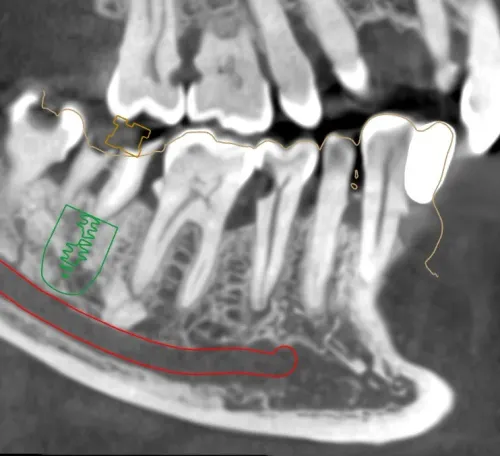
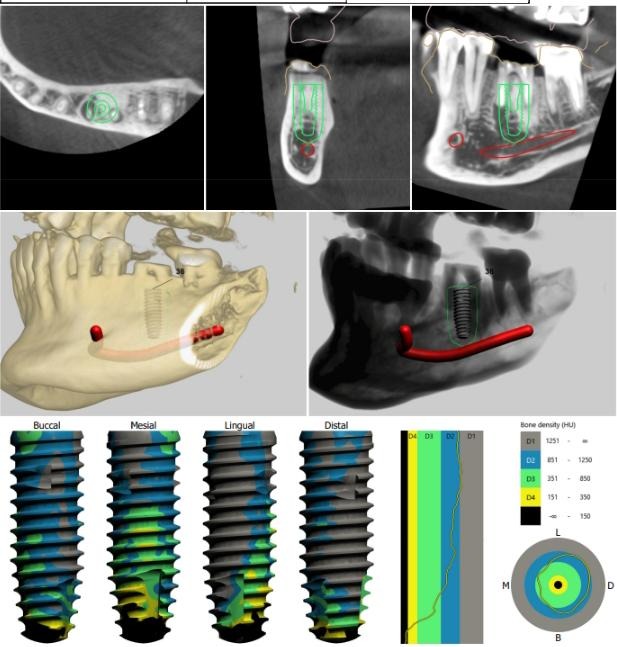
Implant placement should ideally be based on more than a two-dimensional X-ray when three-dimensional anatomy needs to be evaluated.
A CBCT can help assess:
- Bone width
- Bone height
- Bone defects
- Nerve position
- Sinus anatomy
- Root position
- Available implant dimensions
This information can then be combined with the planned restoration.
💻 Digital Implant Planning
Modern digital workflows can make this process more predictable.
A digital implant workflow may combine:
CBCT + intraoral scan + photographs + virtual tooth setup
The dentist can virtually plan:
Where should the final tooth be?
⬇️
Where should the implant ideally be placed to support it?
⬇️
Is there enough bone in that position?
⬇️
Do we need bone or soft-tissue augmentation?
This is fundamentally different from simply placing an implant where bone happens to be available.
🦷 What Is Guided Implant Surgery?
Once the implant position has been digitally planned, a surgical guide may be used in appropriate cases to help transfer that plan to the patient's mouth.
Guided surgery can assist with controlling:
- Implant position
- Angulation
- Depth
- Relationship to neighbouring structures
However, a guide is not a substitute for diagnosis or clinical judgement.
The quality of the digital plan still matters.
🦷 Why Is Position Especially Important for Front Teeth?
The front teeth are the most demanding area aesthetically.
A successful front-tooth implant needs harmony between:
Implant + bone + gum + crown + neighbouring teeth + smile
Even when the implant itself is perfectly healthy, an unfavourable position can contribute to:
- Gum recession
- Asymmetrical gum levels
- Unnatural crown emergence
- Difficulty matching neighbouring teeth
- Poor aesthetics
This is why prosthetically driven planning is particularly important for anterior implants.
🦷 What About Full-Mouth Dental Implants?
Position becomes even more important when multiple implants are involved.
In full-arch treatment, implants aren't planned independently.
Their positions need to work together to support:
- The prosthetic teeth
- Occlusion
- Cantilever management
- Hygiene access
- Prosthetic components
- Overall smile design
Digital planning can help the clinician visualise the relationship between the planned prosthesis and implant positions before surgery.
🦴 What If There Isn't Enough Bone in the Ideal Position?
This is where good planning becomes particularly valuable.
Instead of simply saying:
“There is bone here, so let's put the implant here.”
the treatment plan may consider:
“The implant needs to be here for the final tooth. How can we create the anatomy needed to place it there?”
Depending on the case, this could involve:
- Bone grafting
- Socket preservation
- Soft-tissue augmentation
- Staged implant placement
- Alternative implant positioning
The goal is to create the right foundation for the final restoration.
🧑⚕️ What Should You Ask Your Implant Dentist?
Instead of asking only:
“Which implant brand do you use?”
consider asking:
🦷 “How will you decide the implant position?”
🩻 “Will my implant placement be planned using CBCT?”
💻 “Will you combine my CBCT with an intraoral scan?”
😁 “Can I see the planned final tooth?”
🦴 “Do I have enough bone in the ideal position?”
🧭 “Will you use guided surgery if it is appropriate for my case?”
🪥 “How will the final restoration be designed for cleaning and maintenance?”
These questions give you much more information about the quality of the overall treatment process.
🆚 What Matters When Choosing an Implant Dentist?
When comparing implant treatments, look beyond the brand name.
FactorWhy It MattersDiagnosisIdentifies bone, gum and bite issuesCBCT assessmentEvaluates 3D anatomyProsthetic planningDetermines ideal implant positionImplant systemProvides the implant and restorative componentsSurgical experienceImportant for accurate placementDigital workflowHelps integrate planning informationRestoration designDetermines function and aestheticsMaintenanceImportant for long-term implant health
The best implant treatment is not simply about buying the most expensive implant.
It is about getting the entire treatment system right.
❓ Frequently Asked Questions
Is implant brand more important than the dentist?
The implant system matters, but the diagnosis, treatment planning, surgical placement and restoration are all critical. A reputable implant system cannot compensate for poor planning.
Are expensive dental implants always better?
Not necessarily. Implant systems should be evaluated based on their design, quality, clinical evidence, components and suitability for the case—not simply price.
Can a good implant fail because it was positioned incorrectly?
Yes. Poor positioning can contribute to biological, mechanical, aesthetic or restorative complications.
Is guided surgery necessary for every implant?
No. The appropriate surgical approach depends on the individual case. Guided surgery can be useful in selected situations, but clinical judgement remains essential.
Why is implant position important for front teeth?
Because the position of the implant can influence the gum contour, crown emergence, aesthetics, bone support and ease of maintenance.
Does digital planning guarantee a perfect implant?
No. Digital planning can improve communication and precision, but it does not eliminate biological variation or clinical risks.
🦷 The Bottom Line
When choosing dental implants, don't focus only on the logo printed on the implant box.
A good implant system is important—but the final result depends on a much bigger equation:
Diagnosis + digital planning + ideal implant position + surgical execution + prosthetic design + maintenance
The goal isn't simply to place an implant.
The goal is to place it in the right position to support the right tooth, in the right biological environment, for the long term.
This is especially important for front teeth, complex implant cases and full-mouth rehabilitation.
If you're considering dental implants in Thane or Mulund West Mumbai, ask your dentist not only which implant brand they use, but also how your implant position will be planned and how that position relates to your final teeth.
Procare Dental LLP – Thane & Mulund West, Mumbai
📞 7071876876
Keywords