Losing a front tooth can be particularly stressful. Unlike a back tooth, a front tooth is immediately visible when you smile, speak or laugh.
A dental implant for a front tooth can replace both the missing tooth and its root, providing a stable foundation for a natural-looking crown.
But front-tooth implants require more than simply placing an implant in the available bone. The position of the implant, gum contour, bone volume, tooth proportions and final crown design all have to work together.
If you're considering a front tooth implant in Thane or Mulund West Mumbai, here's what you should know.
🦷 What Is a Front Tooth Implant?
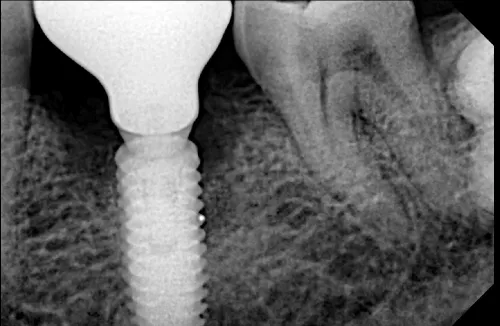
A dental implant is an artificial tooth root, usually made from titanium or another biocompatible material.
For a single missing front tooth, the treatment generally consists of:
Dental implant → abutment → custom-made crown
The implant is placed in the jawbone and, after appropriate healing, supports an individual crown designed to resemble your natural tooth.
Unlike a conventional bridge, the implant does not normally require the adjacent teeth to be prepared as supports.
😊 Why Are Front Tooth Implants More Challenging?
Replacing a front tooth isn't only about function.
The result needs to blend with:
- Your neighbouring teeth
- Gumline
- Smile
- Facial features
- Lip position
- Tooth colour
- Tooth shape
Even a small difference in gum height or crown contour can be noticeable in the front of the mouth.
That's why aesthetic implant dentistry requires careful planning before the implant is placed.
🦷 What Makes a Front Tooth Implant Look Natural?
Several factors contribute to the final result.
1. Implant Position
The implant needs to be positioned appropriately in three dimensions.
An implant that is placed too far toward the lip, too close to the neighbouring tooth or at an inappropriate depth can compromise the final restoration and surrounding tissues.
2. Bone Volume
Adequate bone is important for both implant stability and the shape of the tissues around the restoration.
If bone has been lost following extraction, bone augmentation may sometimes be required.
3. Gum Tissue
The gumline around a front tooth has a major influence on aesthetics.
Soft-tissue thickness and contour can affect how natural the final tooth looks.
4. Crown Design
The final crown must be carefully designed to match the neighbouring teeth in:
- Colour
- Shape
- Width
- Length
- Translucency
- Surface texture
5. The Neighbouring Teeth
The implant crown needs to harmonise with the teeth on either side.
This includes the contact points, tooth proportions and overall smile design.
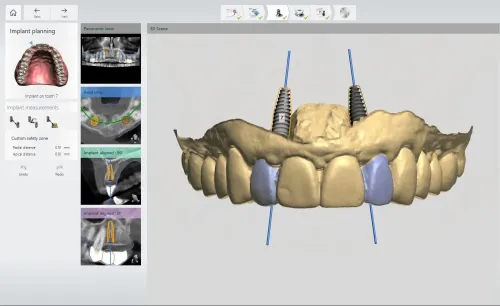
🩻 Why Is Digital Planning Important?
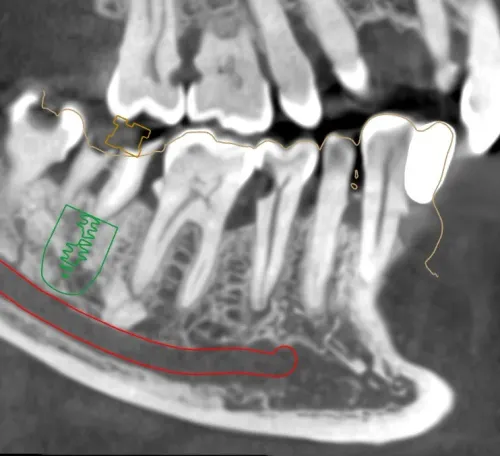
Modern implant dentistry allows the implant to be planned before surgery using digital information.
A digital workflow may combine:
CBCT + intraoral scan + clinical photographs + digital smile planning
This can help the dentist visualise the proposed final tooth and plan the implant position accordingly.
The principle is:
Plan the tooth first. Then position the implant to support that tooth.
This is particularly important in the aesthetic zone.
🦷 Can You Get an Implant Immediately After Losing a Front Tooth?
Sometimes.
In selected cases, an implant can be placed immediately after extraction.
This may be considered when:
- The surrounding bone is favourable
- Adequate implant stability can be achieved
- The gum tissues are suitable
- The extraction site is appropriate
- The implant can be positioned correctly
However, immediate implant placement is not suitable for every front tooth.
If significant bone or soft-tissue damage is present, a staged approach may provide a more predictable result.
🦴 Do Front Tooth Implants Need Bone Grafting?
Not always.
A bone graft may be recommended when:
- The ridge is too narrow
- Bone has been lost after extraction
- There is a significant defect
- The implant cannot be positioned ideally with the available bone
- Additional bone support is needed for aesthetic reasons
In some cases, grafting can be performed at the time of implant placement.
In others, the area may need to heal before the implant is placed.
🦷 What If the Front Tooth Is Still Present but Cannot Be Saved?
If a front tooth is severely damaged or has a poor prognosis, implant planning should ideally happen before extraction.
This allows the dentist to consider:
- How the tooth should be removed
- Whether socket preservation is appropriate
- Whether immediate implantation is possible
- Whether temporary tooth replacement is required
- How the gum and bone can be preserved
Planning before extraction can be particularly valuable in the aesthetic zone.
🦷 What About a Temporary Tooth?
You generally don't have to walk around with a visible gap while waiting for the final implant crown.
Depending on the treatment plan, options may include:
- Removable temporary tooth
- Adhesive temporary bridge
- Temporary bridge
- Immediate provisional crown in selected implant cases
If immediate loading is appropriate, a temporary tooth may sometimes be attached to the implant while it heals.
The final crown is usually placed after appropriate healing and assessment.
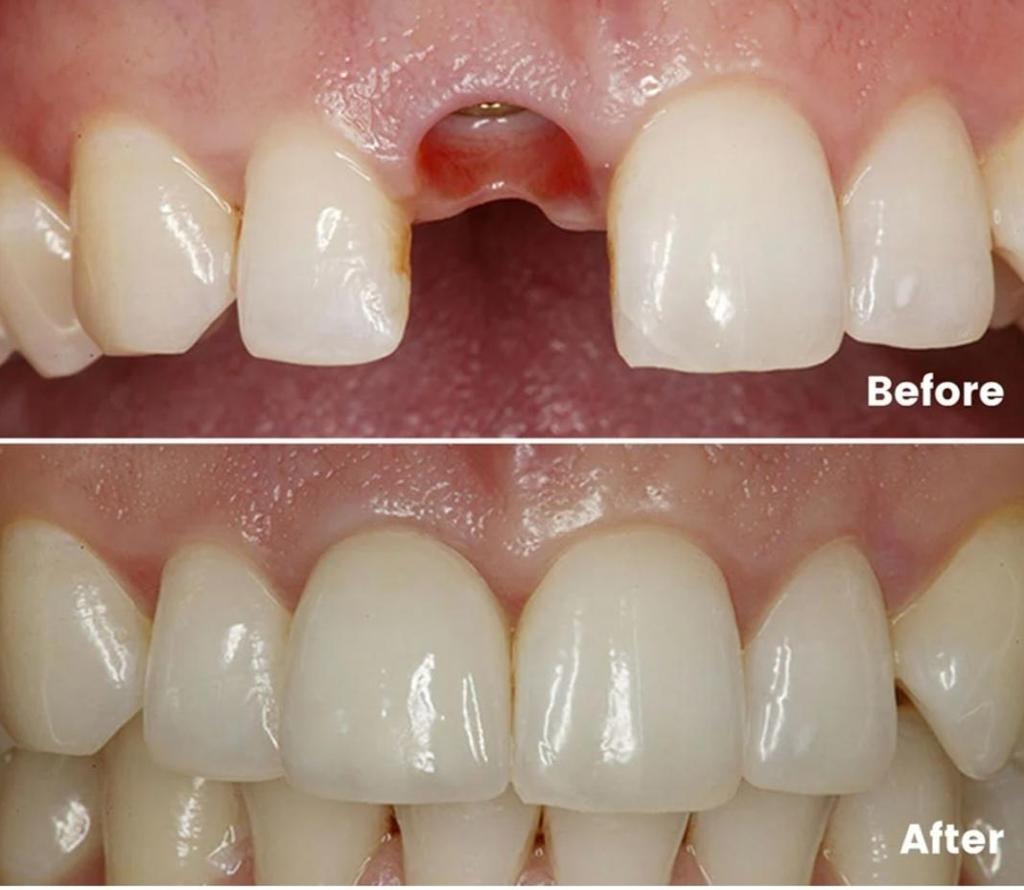
🦷 Can an Implant Crown Look Exactly Like a Natural Tooth?
A well-designed implant crown can look extremely natural.
However, the result depends on several factors beyond the crown itself.
The dentist and dental laboratory need to reproduce:
- Natural tooth proportions
- Shade
- Translucency
- Surface texture
- Gum contour
- Contact points
- Emergence profile
The surrounding bone and soft tissues are equally important.
🦷 What If the Gum Is Receded?
Gum recession or loss of soft tissue around a missing front tooth can make implant treatment more challenging.
Depending on the situation, treatment may involve:
- Soft-tissue augmentation
- Bone grafting
- Modified implant positioning
- Provisionalisation
- Careful crown contouring
A detailed assessment is necessary before deciding on the approach.
🆚 Front Tooth Implant vs Dental Bridge
Both can provide an attractive result.
FeatureFront Tooth ImplantDental BridgeReplaces tooth root✅❌Adjacent teeth usually prepared❌✅Independent restoration✅❌Surgery requiredYesUsually noTreatment timeUsually longerUsually shorterBone assessmentImportantLess relevantGum aestheticsHighly dependent on implant positionDependent on bridge design and tissuesSuitable for everyone❌❌
For a single missing front tooth, an implant can be an excellent option when the neighbouring teeth are healthy and the bone and soft tissues are suitable.
⏳ How Long Does a Front Tooth Implant Take?
The total treatment time varies considerably.
A straightforward case may involve:
Planning → implant placement → healing → final crown
If bone or gum augmentation is required, treatment may involve additional stages and a longer healing period.
Immediate implant placement can shorten the number of surgical stages in selected cases, but it doesn't eliminate the biological healing process.
🦷 How Long Does a Front Tooth Implant Last?
Dental implants can provide long-term tooth replacement when appropriately planned and maintained.
However, an implant is not maintenance-free.
Long-term success depends on:
- Good oral hygiene
- Healthy gums
- Regular dental examinations
- Professional maintenance
- Appropriate bite forces
- Avoiding smoking
- Properly designed restoration
The crown and implant components may have different maintenance or replacement needs over time.
🪥 How Do You Clean a Front Tooth Implant?
Once the final crown is in place, daily cleaning around the implant is essential.
Depending on the restoration, your dentist may recommend:
- Toothbrush
- Interdental brush
- Super floss or specialised floss
- Water flosser
- Professional implant maintenance
Your dentist should demonstrate the cleaning technique appropriate for your particular implant crown.
⚠️ What Can Go Wrong With a Front Tooth Implant?
Although implants have high success rates, complications can occur.
These may include:
- Infection around the implant
- Bone loss
- Gum recession
- Poor implant positioning
- Crown fracture or loosening
- Aesthetic problems
- Inadequate soft-tissue support
Many aesthetic complications can be reduced through careful diagnosis and prosthetically driven planning.
❓ Frequently Asked Questions
Are dental implants good for front teeth?
Yes. A single implant-supported crown can be an excellent option for replacing a missing front tooth when the bone, gums and overall anatomy are suitable.
Does a front tooth implant look natural?
A well-planned implant and custom crown can look very natural. Gum contour, implant position, crown design and shade matching all influence the result.
Can a front tooth implant be done in one day?
The implant and a temporary tooth can sometimes be provided on the same day in carefully selected cases. The definitive crown generally requires appropriate healing and assessment first.
Do I need a bone graft for a front tooth implant?
Not necessarily. A graft is only required when the available bone is insufficient or when augmentation is needed to achieve the desired implant position and tissue contour.
Is an implant better than a bridge for a front tooth?
There is no universal answer. An implant may be particularly attractive when the neighbouring teeth are healthy and you want an independent replacement. A bridge may be appropriate in other situations.
What happens if I have already lost my front tooth?
An implant may still be possible. Your dentist can assess the bone and soft tissues and determine whether direct implant placement or bone/soft-tissue augmentation is required.
🦷 The Bottom Line
Front tooth implants can provide an exceptionally natural-looking replacement—but the success of the treatment begins long before the final crown is made.
The key is to plan:
The final tooth → implant position → bone → gums → temporary restoration → final crown
rather than simply placing an implant wherever there happens to be available bone.
If you're considering a front tooth implant, don't wait until after extraction to start planning. A pre-extraction assessment can sometimes help preserve the bone and gum tissues needed for the best possible aesthetic result.
If you're considering front tooth dental implants in Thane or Mulund West Mumbai, a clinical examination, photographs and CBCT-based digital planning can help determine the most predictable treatment approach.
Procare Dental LLP – Thane & Mulund West, Mumbai
📞 7071876876
Keywords